
INSTALLATION GUIDES / UNDERBODY LIGHTING
Underbody Installation Guide
Plan, mount, wire, and test your underbody LED kit with installation tips and a step-by-step video.

How do you install underbody LED lights?
Test your kit, plan the strip locations and protected wire routes, then clean the mounting surfaces and secure the lighting. Connect the supplied controller and harness to the correct power arrangement for your kit, set up the controller’s app, and test every strip before finishing.
Guide by Lighting Trendz · Updated October 27, 2026
Tools & Materials
- Underbody LED kit, matching controller, and supplied wiring harness
- Phone with the app specified for your controller
- Supplied adhesive tape or mounting brackets
- Zip ties and surface-safe cleaning supplies
- Wire strippers, crimpers, suitable insulated connections, and power connection tools as required
- Optional drill and mounting hardware where suitable for the vehicle
Kit contents and wiring requirements vary. Check your kit instructions before choosing mounting hardware or a power connection.
Step 1: Plan Your Installation
Lay out the strips and extensions before mounting. A four-piece kit generally places two strips along the sides, one at the front, and one at the rear; follow the layout for your kit if it contains a different number.
- Avoid exhaust components, moving parts, excessive heat, road-debris exposure, jack points, and service access areas.
- Check ground clearance and plan protected wire routes behind body panels or along suitable existing wiring paths.
- If lifting the vehicle, use the vehicle’s approved lifting and support procedure. Never work under a vehicle supported only by a jack.
Test the kit before installation using its specified voltage, controller, harness, and any required regulator. For directional strips, connect the input marked DI as instructed. Do not assume every strip or controller accepts a direct 12V connection.
Step 2: Mount the LED Strips
- Clean and dry each mounting area with a cleaner compatible with the surface and adhesive.
- Use the supplied adhesive or brackets to mount the strips in the planned locations.
- Reinforce the installation with suitable zip ties or mounting hardware where directed. Keep jack points and service locations clear.
- Before drilling for brackets, confirm clearance on both sides of the mounting location and avoid lines, wiring, and other components.
- Route and secure wires away from heat and moving parts so they cannot sag or snag. The original guide recommends zip-tie spacing of 12–24 inches, adjusted as needed to support the route.
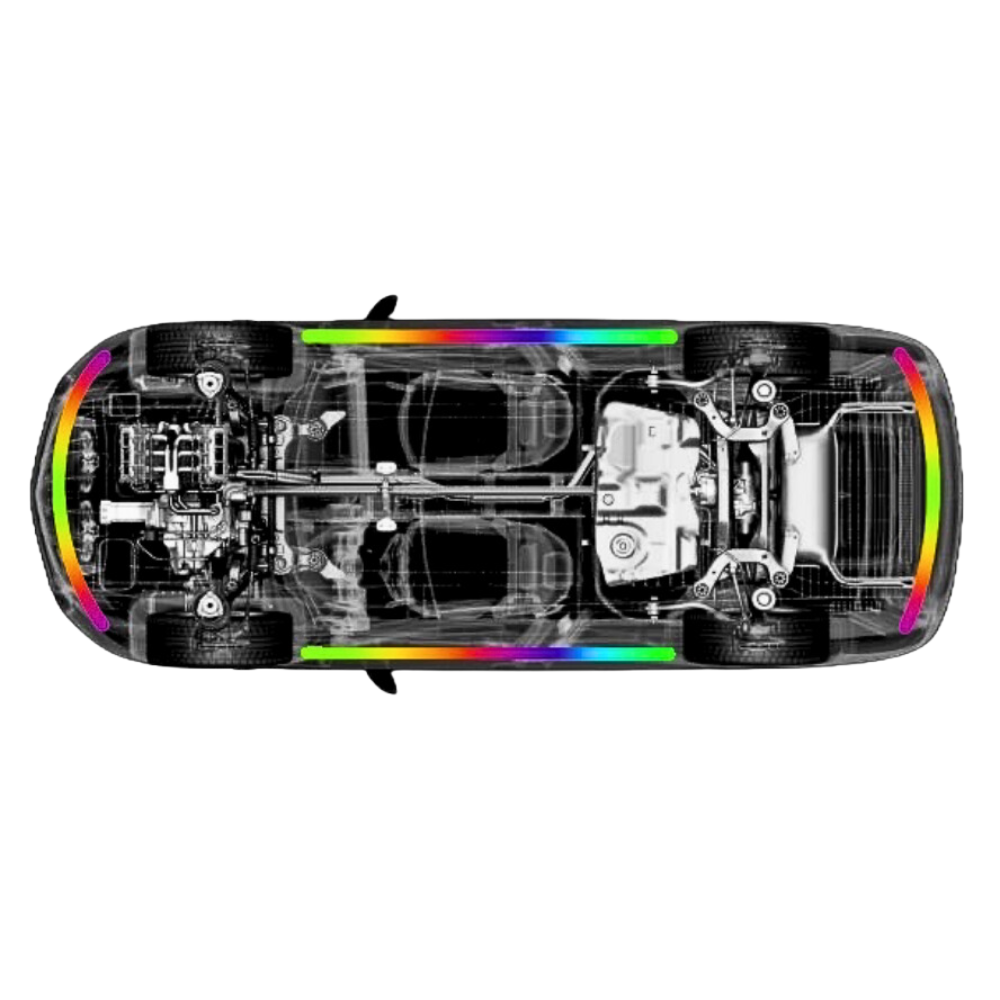
Step 3: Connect to the Power Source
Disconnect vehicle power using the vehicle’s service procedure before making electrical connections. Follow the kit’s voltage, fuse, polarity, and wiring requirements.
- Choose the appropriate battery or fuse-box connection using the vehicle and kit instructions.
- Mount the controller away from engine and exhaust heat. A protected location with airflow near the front bumper may be suitable when allowed by your kit and vehicle layout.
- Connect the labeled positive and negative leads using the supplied harness. If a regulator is required, keep it in the circuit.
- For a fuse-box connection, use an appropriate fuse tap and a circuit suitable for the load. Any power-wire extensions must be properly sized and protected.
- Insulate and weather-protect connections with suitable connectors and heat shrink as required. Secure all extensions away from debris and pinch points.
Water resistance varies by component. Follow the mounting requirements for the controller and connectors supplied with your kit.
Step 4: Program the Bluetooth Controller
- Use the QR code or instructions supplied with your exact controller to identify the correct app.
- Restore power and confirm the controller is powered.
- Enable phone Bluetooth and allow the app’s Bluetooth access if prompted.
- Open the correct app and connect to the controller inside it.
- Test the supported colors, brightness, and patterns.
App choice depends on the controller model, not only on whether the kit is RGB, RGBW, or Flow Series. Follow the controller’s own instructions if it differs from the one shown in the tutorial.
Step 5: Test Your Underglow
- Double-check every mount, connector, and wire route.
- Test all strips and supported effects; confirm that each strip responds correctly.
- Check for loose wiring, heat exposure, and interference with vehicle movement or service points.
- Inspect the installation periodically and after service work to confirm it remains secure.
Watch the Installation Tutorial
Follow the mounting process in our underbody tutorial. Use your kit’s instructions for any controller or wiring differences.
Common Questions
Where should underbody LED strips be mounted?
Use suitable locations along the sides, front, and rear for your kit. Avoid exhaust heat, moving parts, jack points, and service access areas, and check ground clearance.
Should I test the kit before mounting it?
Yes. Test the strips, controller, and wiring with the voltage and components specified for your kit before securing the installation.
Which app controls my underbody kit?
Use the app identified by your exact controller’s QR code or instructions. Different controllers can use different apps even within the same lighting type.
Can every underbody strip connect directly to 12V?
No. Follow the voltage and wiring requirements of your specific kit and keep any required regulator in the circuit.
Need More Assistance?
Contact our team with your kit and controller model, vehicle details, and photos of the installation.